
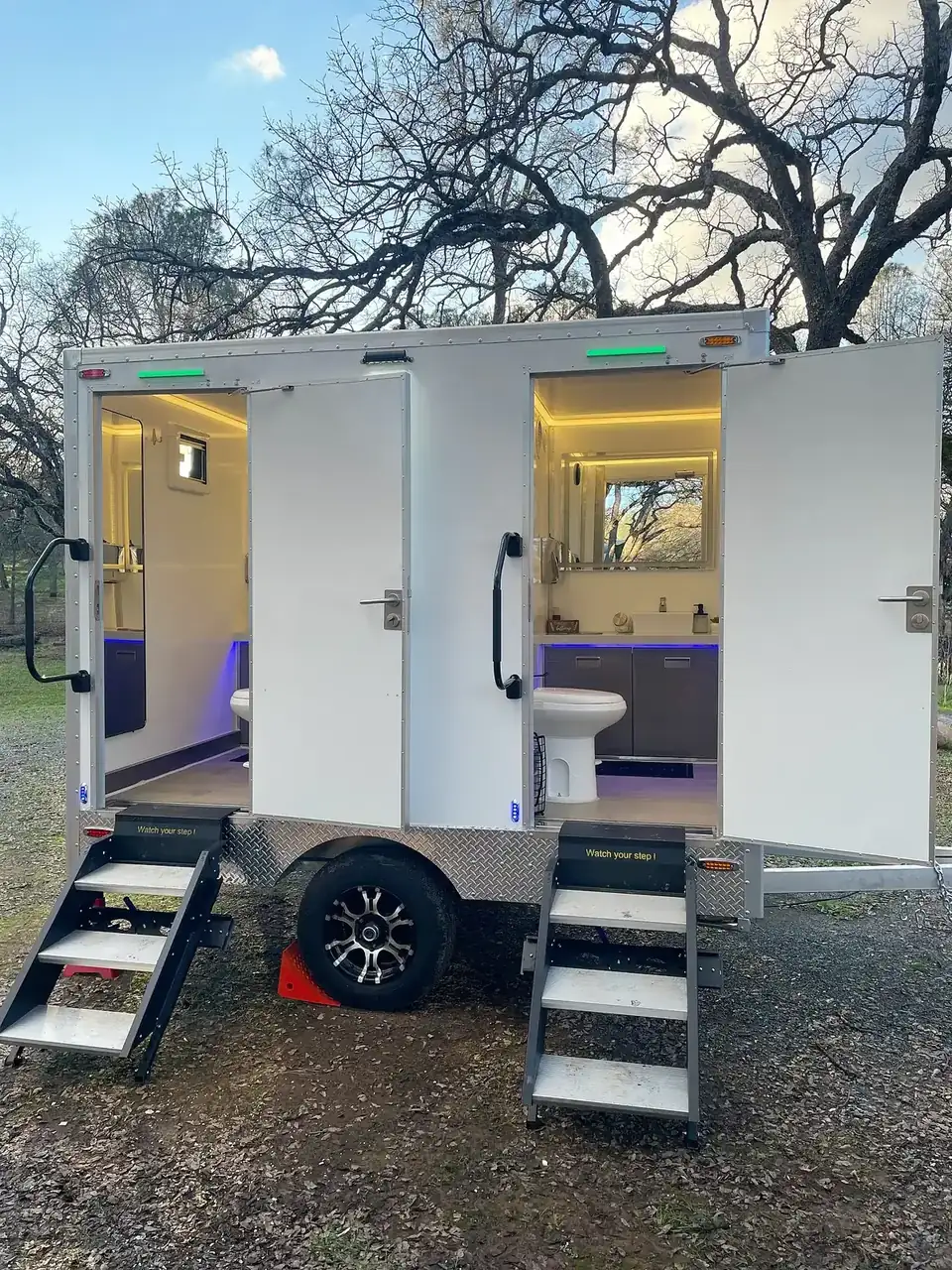
Is a restroom trailer or a porta potty better?
A restroom trailer is better for formal events with a 110V outlet and a hose within 100 feet; porta potties are better for fields, job sites and tight budgets. One two-stall trailer serves about 100 guests over 5 hours. The same crowd needs 2–3 porta potties.
| Restroom trailer (2-stall) | Porta potties | |
|---|---|---|
| Guests served (5 hrs) | About 100 | About 50 per unit |
| Toilets | Porcelain flush | Seat over tank, or foot-pump flush |
| Hand washing | Running-water sinks | Sanitizer, built-in sink or separate station |
| Hookups | 110V outlet + hose | None |
| Space | About 8 × 16 ft plus truck access | About 4 × 4 ft each |
| Starting price | From $995 per weekend | From $175 per unit |
When is a restroom trailer worth the cost?
A restroom trailer is worth it for weddings, formal parties and corporate events where guests dress up, events run after dark, or weather is hot. Climate control and lighting matter more as the event gets longer and more formal.
When are porta potties the smarter choice?
Porta potties are the smarter choice for job sites, pastures, ballfields, festivals spread over a large area, and any site without power or a level truck path. Units can be split into clusters near each activity, which a single trailer cannot do.
Can I mix a trailer and porta potties?
Mixing works well: put the trailer near the reception for guests and a few standard units near parking, the kitchen tent or the band area. Add 1 wheelchair-accessible unit if the trailer's steps are a barrier for any guest.
Compare every unit on the porta potty types guide.
Related questions
Does a restroom trailer have steps?
Restroom trailers sit on wheels, so each door has 2–3 fold-down steps. Guests who cannot use steps need a ground-level accessible unit.
How long does trailer setup take?
Setup takes about 30–45 minutes: backing in, leveling, connecting power and water, and a final check. It is done the day before the event.